
Vicky Oldfield has written an amazing book entitled Mixed-Media Collagraph Prints which is full of inspiring creative techniques. Last week I explored her suggested use of self-adhesive aluminium tape when creating collagraph plates.
Her book details the use of both adhesive tape and regular foil used with spray adhesive. I have a roll of 3″ (7.5cm) wide adhesive tape and went with that. The main issue with this is that it, obviously, only covers a narrow area so you need to abut numerous lengths to make a decent size print matrix.
Each example started with a mountboard (matte board) base with the tape adhered to the surface.
Intaglio with plant material:
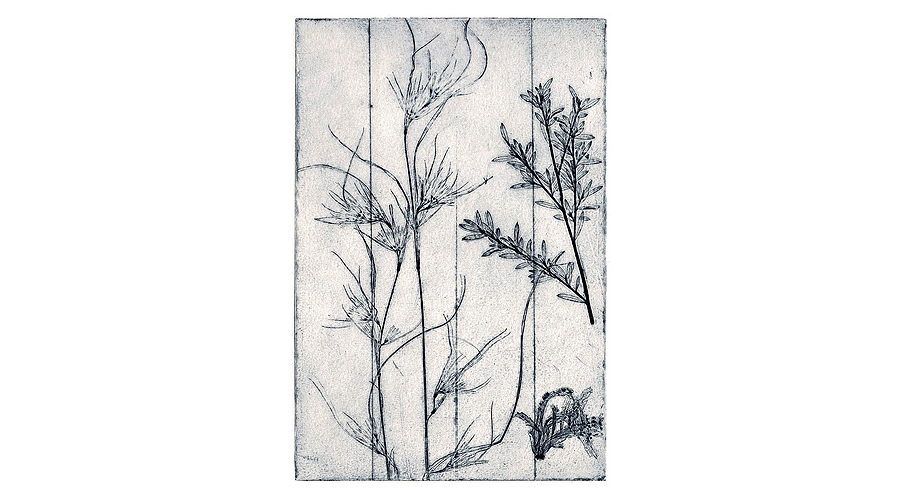
Three pieces of self-adhesive aluminium tape were overlaid across the surface of the board, dried plant material was placed over this and the plate was run through the etching press to emboss the plants into the surface. When doing this it’s important to place a solid surface over the top before running through the press; book board, another piece of matte board or similar works well. This stops potential damage to the press roller and also helps to press the plants into the lower surface.
Plants were removed, ink applied and wiped back, dampened paper was placed on top along with a thin piece of foam which helped the dampened, more flexible, paper to reach the lower inked areas – a common practice when printing collagraphs.

Above left shows the aluminium surface before inking, on the right is the printed result.
Trapped plant material:
In this experiment the plants were placed onto the mountboard first with the tape overlaid. This is quite difficult with tape as it’s not repositionable and it’s hard to get into the detail of the trapped material. I used a ball-end stylus around some of the finer areas to try to create more definition. The tape, and probably foil if using that, will also buckle as can be seen from the photograph.

Two individual pieces of tape were used without overlapping. The buckling is evident but can create interesting textural effects and the plants are printed as an outline, quite different from the first sample.
Intaglio with wire:
Using 18 gauge wire I fashioned some flower shapes before lying them on the foil covered mountboard in the same way as the first plant samples, and ran the board through the press. However, I decided against strips of tape and cut shorter lengths, placing them in different directions and overlapping more randomly.
**VERY IMPORTANT: It’s essential to ensure you have a THICK and ROBUST board on top of your matrix + wire before going through the press to create the embossed surface. You do not want to risk damaging the roller.

Embossed wire on foamex board:
To explore another effect I embossed the wire flowers into 3mm foamex board (available from the hardware store – Bunnings in Australia), inked and printed. I wanted to see the difference between this and the tape effect.

I tried to place them in exactly the same position so I could compare the two collagraph surfaces. I like both but for different reasons. The foamex board gives a stark, very crisp and even result, whereas the foil surface retains the overlapping lines – which print well – adding interest and the ink coverage is more uneven and shadowy.
Scope for both processes I think.
Thanks go to Vicky Oldfield for introducing me to this new collagraph approach.
Resources:
Vicky Oldfield, Mixed-Media Collagraph Prints, 2022, The Crowood Press, ISBN 978 0 7198 4106 4, Pages 34-41

Leave a Reply