

Project: Order from Chaos
My last post Pushing a print project further explored making a new etching plate from ideas previously worked. It came out quite well but the complexity of overprinting multiple plates attracts me more than the single plate I produced. When designing this image I referred back to my previous plates and prints and realised how much I still love them and also saw where the printed image could be improved.
Firstly, the key plate needed more dynamism. Previously I’d printed it in stormy grey and whilst this is an amazing colour I now opted for black to achieve a stronger and sharply outlined image.
Secondly, in my original iteration (here) I inked the second plate in a single colour, sanguine. I loved the outcome, although I knew there was more to come with colour choices and further exploration happened as I used these plates, layering them with monoprints. This time round I applied different inks à la poupée.

In this case the black was printed first with the coloured plate overlaid. That’s fairly unusual as the key plate (my black one) is normally last and pulls the whole piece together. I hoped that by putting the colours atop the black it would keep them fresher and any plate tone from the darker plate would remain behind and be somewhat camouflaged by any coloured plate tone there may be. And I think it’s worked.
I first applied a layer of sanguine across the whole surface and wiped away more strongly in the areas where I intended other colours to be. This method aids the intensity of the following overlaid colours. I chose ocean blue and primrose yellow as my other colours, applying them to the individual areas and allowing them to blend where I required green.
When working this way it’s important to know that inking up and wiping back to minimize plate tone interference takes time, it’s not a process to be rushed if you want good results.
Another thing to remember is the orientation of your plates and a good rule to follow is to mark the back of each one somehow; perhaps draw a directional arrow or write ‘TOP’. I always mark mine and it’s REALLY USEFUL to actually READ and follow those markings.
Here’s what happens when you don’t.

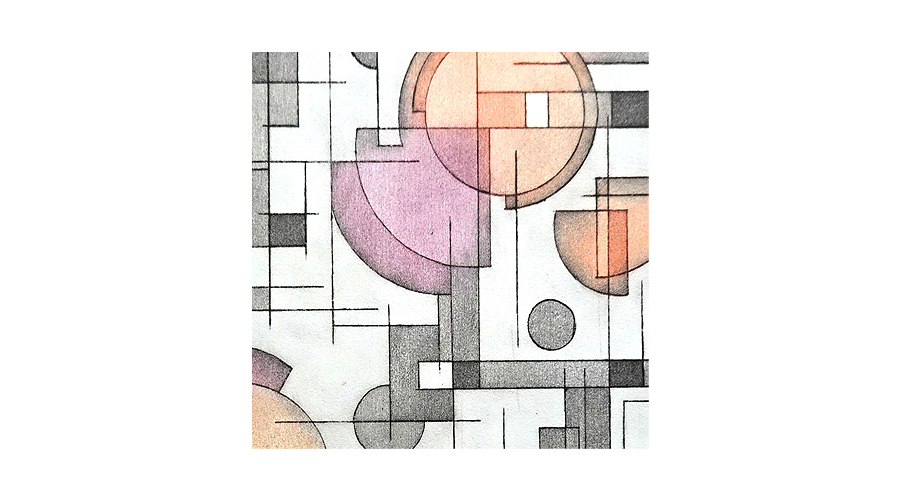
Oops! The finished print has had to be rotated because the original orientation had all the weight – effectively the heavier dark areas- sitting to the right. The way it is shown here more evenly distributes that, although there is more density across the top.
I’ve entitled this project Order from Chaos as a result of this mistake. The incorrectly registered piece seems cluttered and disorganised, whilst the correctly placed piece appears substantially more cohesive.
However, you make your own choice.


Leave a Reply to HelenCancel reply