
A couple of years ago, in a Jet James workshop, I made this print plate from 3mm foamex board (anyone following my blog will know by now that I love this stuff).
 Several techniques were used to create this intaglio/collagraph print plate. Initially some plant material was embossed into the surface, masking tape was crumpled and adhered, a craft knife slashed into the foam, lino-cutting tools both carved and compressed the foamex to form the pods and a metallic pen created a resist here and there. All worked well.
However, there is one drawback with this product; techniques used to compress the surface, such as embossing, gradually decompress and the images become less distinct. In fact, the plates can have quite a short print-run life.
Here’s my print from 2 years ago:
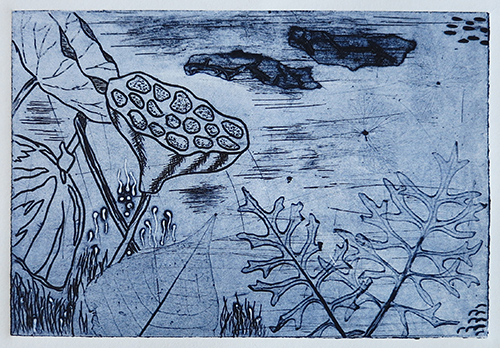 Very detailed and the definition of the skelitonised leaf coming in from the base of the pod stems is quite detailed, as is the other embossed foliage to the right. However, looking at the plate 2 years on I could immediately see that the skelitonised leaf was almost gone, so I redrew the outline with a fine stylus.
 My skelitonised leaf looks very ‘drawn’ as opposed to the original embossing but there’s no alternative to that, and this print trial showed me that other sections weren’t retaining the ink at all well. So I was forced to redraw as much as possible, as accurately as possible.
Here are two good outcomes from the plate. Both use the same colour scheme but with a slightly different spread and they demonstrate great definition. I’ve been wanting to print this image in colour for quite a while now and I’m really pleased with the results.
 All the above are intaglio prints but I also managed a lightly rolled relief print – whereby the ink sits on the surface and the image comes out in reverse.




Leave a Reply