
Colour Preparation.

- Basic colour wheel
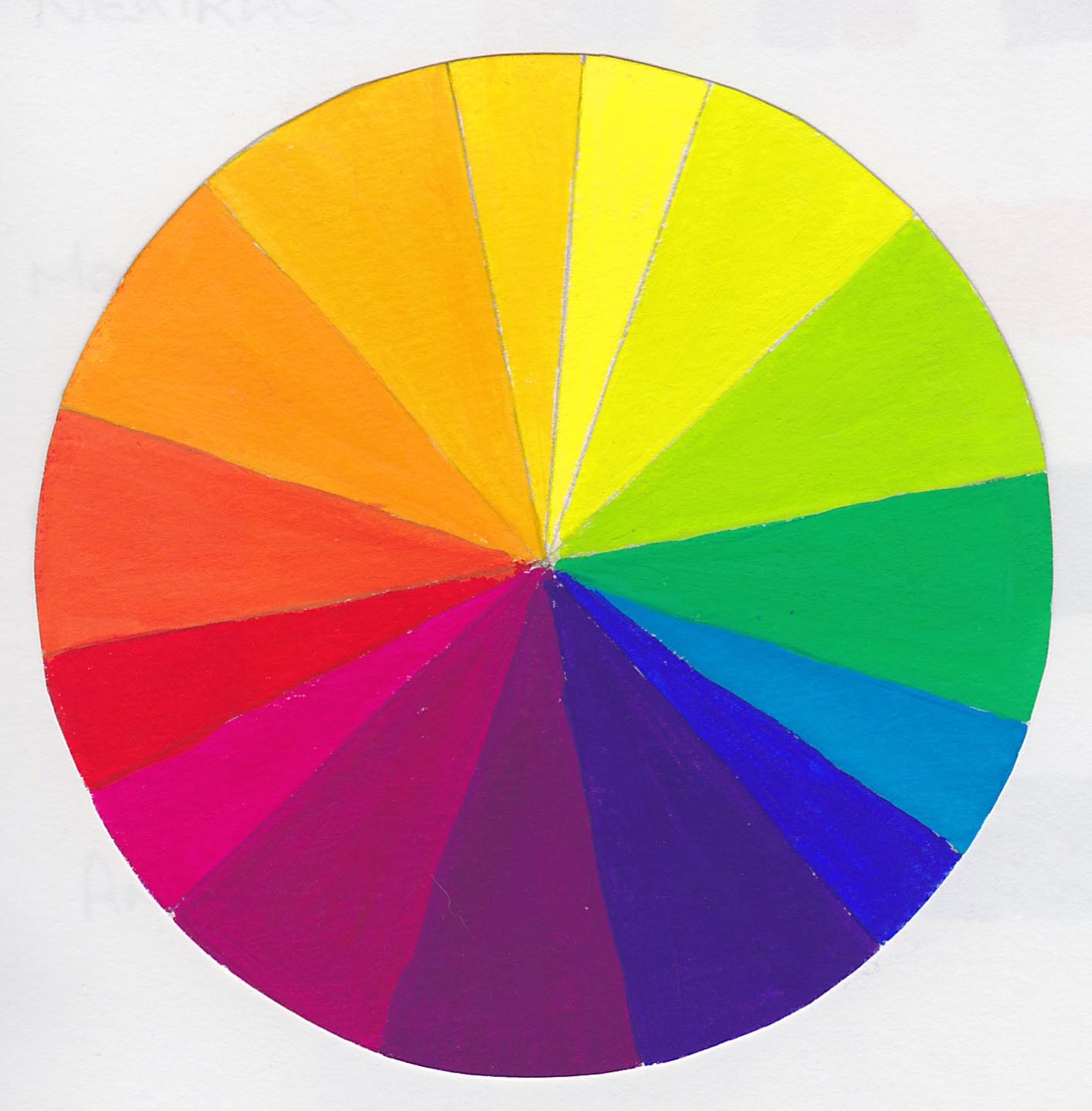
Over the years I’ve painted the colour wheel several times, from the basic one (left) to the more complicated (below).

It still remains a very useful tool that I have hanging in my workroom for reference. It sits beside one I bought which shows tinting and shading of the colours as well as indicating complementary, split-complementary, triads, and tetrads. Explanations are given for all. It also gives details of colour terminology and has a printed grey scale.
For this exercise I decided to go the whole way and paint the wheel in full (12 sections) using the warm and cool colours in each of the three primary hues. It has taken an age to do it but I feel that I now have an even more complete visual aid.

- Full colour wheel

For the cool colours I have used Process Yellow, Process Magenta and Process Cyan. For the warm colours I have used Brilliant Yellow, Scarlet and Ultramarine.
In each section both warm and cool colours are mixed with the following warm and cool colours, so giving four variations in colour progression. Starting at the top centre, indicated by the black spacer lines, are the two yellows which travel clockwise to the two reds and then on to the two blues (all also outlined with black spacer bars) finally ending up back at the yellows.

I also scanned it into the computer in grey scale to see how the colours come out which has been a revelation.
I know, from using a red Value Finder on a regular basis, that tonal values of some colours can be very deceptive.


Leave a Reply